Wilhelm Elinashe Uutoni1, Jaya Raju2, Trywell Kalusopa3
1Department of Knowledge and Information Stewardship, University of Cape Town, Republic of South Africa
2Department of Knowledge and Information Stewardship, University of Cape Town, Republic of South Africa
3Office of the Deputy Vice Chancellor – Research and Innovation, University of Zambia, Republic of Zambia
Correspondence to Wilhelm Uutoni, Email: wuutoni@unam.na
Volume 2, Number 1, Article 3, December 2025.
International Journal of Documentary Heritage 2025;2(1):3. https://doi.org/10.71278/IJODH.2025.2.1.3
Received on August 01, 2025, Revised on November 03, 2025, Accepted on November 14, 2025, Published on December 30, 2025.
Copyright © 2025 Author(s).
This is an Open Access article distributed under the terms of the Creative Commons Attribution 4.0 International License (CC BY 4.0) (https://creativecommons.org/licenses/by/4.0/).

This article explores e-deposit of Namibia’s documentary heritage at the National Library of Namibia and proposes a digital preservation framework for the country’s documentary heritage. The study triangulated the Open Archival Information System (OAIS) Reference Model and the Digital Preservation Capability Maturity Model (DPCMM), which helped to unpack digital preservation concepts. Within the pragmatic paradigm, the study adopted a convergent parallel mixed methods approach and employed a single case study design. The study population consisted of users of the National Library of Namibia, the management of the Namibia Library and Archives Service (NLAS), and board members of the Namibia Library and Information Council (NLIC). Respondents in the quantitative part of the study were selected using a convenience sampling method, while participants in the qualitative aspect of the study were selected using a purposive sampling method. Quantitative data were collected using semi-structured questionnaires, while qualitative data were collected using semi-structured interview guides and a document search guide. The study’s findings revealed that the National Library of Namibia does not have a policy or guidelines to regulate the handling of electronically deposited resources or the harvesting of electronic resources. The study proposes a digital preservation framework for the National Library of Namibia and the Namibia library and information sector. This framework could assist the National Library of Namibia in developing policies and guidelines to regulate the digital preservation of Namibia’s documentary heritage for posterity.
Digital preservation, Digital preservation framework, Documentary heritage, National Library of Namibia
This article is part of a broad study that focused on the digital preservation of documentary heritage at the National Library of Namibia. The National Library of Namibia was established in 1926 and has been serving as the reference and subject library. The mission of the National Library of Namibia is to facilitate access to information for all Namibians and Namibian libraries, as well as to support education and research by providing access to national and international information resources (Loubser, 2003). Additionally, the National Library of Namibia has a national responsibility to promote local content creation by encouraging writing in local languages (Ministry of Education, 2012).
With the largest collection of Namibian publications, the National Library of Namibia boasts an extensive archive that includes over 90 newspaper titles, various books (including brochures and pamphlets), more than 1,600 periodical titles, Namibian-related theses, manuscripts, cassettes, posters, and CD-ROMs (Loubser, 2003). As per Section 5 of the Namibia Library and Information Service Act 4 of 2000 (Republic of Namibia, 2000), the National Library of Namibia is mandated to fulfil the following functions: provide support services and conduct research to ensure the provision of library and information services to the people of Namibia; serve as the national centre for conserving materials originating from Namibia or about Namibia; act as a hub for the collection and preservation of literary manuscripts; develop a collection of materials originating from Namibia through legal deposit or other means; and promote awareness and appreciation of Namibia’s national heritage (Republic of Namibia, 2000; Loubser, 2003; Senzanje & Jacobi, 2012).
The information sources (documentary heritage) gathered by the National Library of Namibia through legal deposit are held in a physical closed-access collection. These collections may be accessed in the National Library reading rooms to minimize the handling of the materials to ensure their permanent preservation (Smith et al., 2008).
Section 8 of the Namibia Library and Information Service Act 4 of 2000 specifies the legal deposit requirements for documents intended to be generally available in Namibia. It mandates that government offices deposit 20 copies of such documents with the National Archives of Namibia, while non-government producers are required to deposit five copies in the prescribed format and quality with the National Library of Namibia within 14 days of the document becoming generally available (Republic of Namibia, 2000). This legal deposit applies to materials produced in, about, or by Namibians at the expense of the producer and is utilised to compile a Namibian national bibliography and statistics on national book production. The deposited documents remain as the properties of the National Library, and for preservation purposes, the Head of the National Library is required to deliver one copy to each designated place of deposit, namely the Namibian National Assembly Library, Keetmanshoop Community Library, and University of Namibia Oshakati Campus Library (Republic of Namibia, 2000).
Although the Namibia Library and Information Act 4 of 2000 outlines legal deposit procedures, it does not specify the prescribed format of documents for legal deposit. Therefore, this study investigated the provision of e-deposit to the National Library of Namibia. Hillebrecht (2010) identified the following shortfalls regarding the legal deposit of documentary heritage in Namibia: (1) Although the legal deposit is mandatory, the deposit relies on voluntary cooperation as some depositors are not convinced of the values in having their resources added to a public collection; and (2) The number of five copies is seen as a heavy burden by small self-publishers. Hillebrecht (2010) posits that Namibia’s cultural heritage is in danger of being irretrievably lost if opportunities of preserving it are not seized, and recommends that Namibia take necessary steps, including legislative provisions, institutional empowerment, and human resource capacity-building.
The National Library of Namibia serves as a national centre for the collection, preservation, and access to Namibia’s published national heritage (documentary heritage) through legal deposit (Republic of Namibia, 2000). The Namibia Library and Information Service Act 4 of 2000 does not stipulate provisions for e-legal deposit. Therefore, this study seeks to establish the stance of the National Library of Namibia on e-legal deposit. The study further explores the National Library of Namibia’s role in acquiring electronically published documentary heritage and establishes the extent to which the National Library of Namibia is prepared to embrace the concept of digital legal deposit. The findings of the study are used to propose a digital preservation framework for the National Library of Namibia and the Namibia library and information sector. This paper is based on the following critical questions:
1. To what extent is the National Library of Namibia prepared to embrace digital legal deposit?
2. What digital preservation framework is appropriate for the National Library of Namibia?
Digital legal deposit, also known as e-deposit, is based on ingest, a component associated with web archiving in the Open Archival Information System (OAIS) Reference Model, a theoretical model used in this study (Verheul & Van Wijngaarden, 2007). E-deposit introduces new dimensions to legal deposit that are not present in print deposits, such as the involvement of publishers in setting up the deposit process, electronic user access, digital rights management, and data protection (Gibby & Green, 2008). Legal deposit has a significant impact on multiple facets of digital preservation (Verheul, 2006). Its primary objective is to guarantee the enduring preservation of a country’s intellectual and cultural heritage (Muir, 2001).
Although national libraries in the developed world seem to embrace digital legal deposit, much is not known or documented about digital legal deposit and national libraries in Africa, to the best of the researchers’ knowledge. One of the African countries that surfaced in the literature on e-deposit is South Africa. In 2004, the National Library of South Africa initiated an examination of electronically published documents, identifying them as part of the legal deposit domain (Drijfhout, 2007). Digital legal deposit allows the collection and archiving of digital content, such as e-books, e-journals, and website content. Research conducted by De Beer et al. (2016) regarding the obstacles national libraries encounter in handling legal deposit of electronic books revealed significant challenges. These included the absence of legislation specifically addressing legal deposit, as well as the lack of institutional policies and procedures established for depositing such materials. Legal deposit legislation should include two categories of electronic publication. The first category comprises offline or tangible publications, which are information sources made available on physical data carriers, such as diskettes and CD-ROMs. Legal deposit legislation should explicitly mandate the deposit of digital materials alongside any related software manuals and accompanying materials necessary to facilitate their use. The second classification encompasses online materials, which are resources solely existing as a single copy stored on a computer host system or within the global collection of computer systems known as the internet (Larivière, 2000). Larivière (2000) underscores the significant challenge of technological obsolescence in achieving the long-term accessibility objective for researchers in the context of electronic legal deposit. Consequently, it is imperative for legal deposit legislation to authorize national libraries to undertake actions such as copying, reformatting, or migrating deposited publications for preservation purposes.
Nsibirwa et al. (2014) observe that many countries are undergoing revisions or have already revised their legal deposit legislation in response to the significant rise in electronic publications. This trend is evident in Namibia as well. In countries like Estonia, the collection and archiving of online publications have become routine tasks for the national library. This shift was facilitated by the enactment of the Legal Deposit Copy Act in 2006, driven by the necessity to establish a digital archive for long-term preservation purposes (Andresoo, 2009). A study conducted by the British Library found that the emergence of online publishing has prompted national libraries worldwide to prioritise the capture of e-publications and engage in web archiving efforts (Stephens & Gibby, 2011). Besides embracing e-deposit, several national libraries in Europe have introduced the concept of ‘web archiving’ resources that are not necessarily deposited in libraries but are available online. In Estonia, for example, when selecting these web resources, one of the principles is that such sources contain important information from a cultural heritage perspective (Andresoo, 2009).
A study conducted by the British Library in 2009 to assess the status of legal deposit for electronic publications in 34 national libraries across Europe revealed that the majority of these countries had enacted and implemented legislation that imposes legal deposit obligations or allows libraries to archive materials for at least one category of electronic publishing (Stephens & Gibby, 2011: 59). Legislation on e-legal deposit entails considerations of various issues, including evaluating technical deposit processes, determining territoriality (place of publication), managing electronic user access and copying, implementing digital rights management, addressing digital preservation concerns, and ensuring compliance with data protection regulations. These considerations are typically not addressed in traditional print legal deposit legislation (Stephens & Gibby, 2011). The British Library survey revealed a widespread adoption of e-legal deposit laws in European national libraries, with 82% of respondents indicating implementation (Stephens & Gibby, 2011). These laws typically permit the collection of freely available websites as well as commercial or protected online publications. However, Alexandrov’s study (2018), focusing on the transformation of digital legal deposit, particularly legislative and public access regulations, highlighted that full implementation of digital legal deposit has not yet been achieved in all European Union (EU) member states. Alexandrov (2018) concludes that the major challenges for further development of digital legal deposit are specified as legislative, technological, financial, and social.
By the year 2000, several European countries had included electronic publications in their legal deposit legislation, but in Africa, South Africa was the only country noted to have included electronic publications in its legal deposit legislation (Larivière, 2000). However, research conducted by Nsibirwa et al. (2014), examining the legislative, regulatory, and policy framework related to the preservation and access of legal deposit materials, discovered that while the South African Legal Deposit Act covers electronic materials, most depositories lacked policies for managing or collecting such materials. The status of other African countries, including Namibia, regarding this matter was unclear at the time of the study. Therefore, this research aimed to assess the status of e-deposit at the National Library of Namibia.
Notable e-deposit challenges include some publishers not responding to libraries’ requests, while others outright declined to allow their sites to be harvested (Elliott, 2011). The Dutch National Library’s 2005 study in Europe and the USA revealed that libraries engaged in web harvesting and archiving expressed concerns about the suitability of storage and access systems for long-term preservation and permanent access (Verheul & Van Wijngaarden, 2007). Larivière (2000) stresses the importance of involving all national legal deposit agencies in discussions, highlighting their crucial role in preserving cultural and intellectual heritage and ensuring democratic access to information. De Beer et al. (2016) note that national libraries undertaking legal deposit of electronic publications face various challenges, including legal deposit legislation and institutional policies. In Namibia, Senzanje’s (2014) study exploring publishers’ knowledge, attitudes, and practices toward legal deposit identified challenges, such as publishers’ failure to deposit their publications with the National Library of Namibia.
The study triangulated the Open Archival Information System (OAIS) Reference Model and Digital Preservation Capability Maturity Model (DPCMM) as theoretical models to understand digital preservation at the National Library of Namibia. The OAIS Reference Model has been widely accepted by the digital preservation community to date (Voutssas, 2012), and it provides a framework for building and maintaining long-term preservation and access to digital materials (Verheul, 2006). The OAIS Reference Model also functions akin to a conceptual blueprint, outlining the core components of a preservation repository and the information objects managed within it (Lavoie, 2014). The DPCMM draws upon functions and preservation services, and it is based on OAIS Reference Model functions, the International Organisation for Standardisation (ISO 14721), and trustworthy repository audit criteria (ISO 16363, space data and information transfer systems-audit and certification of trustworthy digital repositories), so this combination establishes a high threshold for digital preservation capabilities (Dollar & Ashley, 2015).
Two components, namely Ingest and Security of the OAIS Reference Model and the DPCMM, were observed in the current study.
Ingest refers to receiving and accepting electronic records from their producers (Dollar & Ashley, 2015). Ingest provides the services and functions to accept submission information packages (SIPs) from producers (Strodl et al., 2007). It is a set of processes responsible for accepting information submitted by producers and preparing it for inclusion in the digital repository. Specific Ingest functions include the receipt of information transferred to the OAIS by a producer; validation that the information received is uncorrupted and complete; transformation of the submitted information into a form suitable for storage and management within the archival system; extraction and creation of descriptive metadata to support the OAIS’s search and retrieval tools and finding aids; and the transfer of the submitted information and its associated metadata to the archival store (Consultative Committee for Space Data Systems, 2012).
The Ingest function serves as the OAIS’s external interface with producers, managing the entire process of accepting custody of submitted information and preparing it for archival retention (Consultative Committee for Space Data Systems, 2012; Lavoie, 2014). Ingest further performs quality assurance and generates information sources that comply with the set standards (Strodl et al. 2007). With Ingest, a library receiving documentary heritage needs to operationalise or set formats of resources it will accept, especially with e-deposit. This study used the Ingest component to investigate the extent to which the National Library of Namibia is prepared to embrace digital legal deposit. The findings from this research question provided an understanding of the nature and prospects of the electronic documentary heritage deposit at the National Library of Namibia. These findings were also useful for proposing a digital preservation framework for the National Library of Namibia and the Namibia library and information sector.
Digital preservation necessitates processes that control access to the physical repository housing digital content, guarantee the security of electronic records through measures that prevent unauthorised access, safeguard the confidentiality and privacy of records and intellectual property rights, facilitate regular backup of electronic records stored at off-site storage facilities, and enable disaster recovery and business continuity measures (Dollar & Ashley, 2015). This aspect was used in this study to investigate the following research question: “What digital preservation framework is appropriate for the National Library of Namibia?” The findings of this research are envisaged to shed light on the practices of protecting documentary heritage content in terms of user privacy and confidentiality. The findings are also expected to assist the development of a proposed digital preservation framework for the National Library of Namibia, as well as the Namibia library and information sector.
The study adopted a single case study design. The study used a pragmatic paradigm and a mixed methods approach to explore the extent to which the Namibian legal deposit framework makes provision for the deposit of electronic information sources to the National Library of Namibia and what digital preservation framework is appropriate for the National Library of Namibia. The study focused on the following units of analysis: the Namibia Library and Archives Service (NLAS) directorate, the Namibia Library and Information Council (NLIC) Board, and the National Library of Namibia staff, whose responses were required to address the overall objective of the study. The study also included three management members of the National Library of Namibia: the Head of the National Library of Namibia, a senior librarian responsible for the user service department, and a senior librarian responsible for bibliographic services. Purposive sampling was used to select the NLAS management members, NLIC members, and three senior staff members of the National Library of Namibia.
In this study, semi-structured interview guides were targeted at NLIC members, the NLAS, the NLAS Information Technology, and the National Library of Namibia staff. Some participants opted for virtual interviews, so these interviews were conducted via Microsoft Teams and Zoom. A further data collection method used in this study was the search for existing relevant documents. In this study, the following documents were reviewed and analysed: policy documents, NLIC’s meeting minutes and research reports, government publications, NLAS and the National Library of Namibia’s publications, the National Library of Namibia’s website, and any published or unpublished documents the researcher could locate that contained information on legal deposit, electronic legal deposit, preservation of resources at the National Library of Namibia, and digital preservation. The researcher administered similar questions to different participants (Librarians, NLAS staff, and NLIC members).
This section presents and discusses the findings of the study on Namibia’s legal deposit framework for electronic information sources, and the preservation framework appropriate for the National Library of Namibia.
The study sought to understand whether, besides legal deposit, the National Library of Namibia was, to a certain extent, harvesting e-publications as pointed out by the management staff of the National Library of Namibia. The electronic documents received by the National Library of Namibia included: The Observer newspaper, books from some publishers, journals, and annual plans and strategic plans from some ministries. These materials were received in PDF format. Responses from the National Library of Namibia management staff indicated that the National Library of Namibia did not have a framework in place to facilitate e-legal deposit or to legally compel publishers to deposit electronic publications. Since the National Library of Namibia is mandated to issue International Standard Book Numbers (ISBNs) and International Standard Serial Numbers (ISSNs), it negotiates with publishers to deposit their publications when issuing these numbers. In addition to publishers voluntarily depositing their publications, the National Library of Namibia harvested e-publications by means of contacting ministries, publishers, etc. The National Library of Namibia indicated that the responses were good, and at times, it received downloading links to e-publications.
The practice of e-deposit and document harvesting, also known as web archiving, has changed in the library fraternity globally. For instance, Stirling et al. (2012) explain that the Bibliothèque Nationale de France (BnF) has established a system of web archiving involving technical solutions, both hardware and software, and also organisational elements, as this mission requires the expertise of digital curators. Similarly, a study by Cadavid (2017) found that e-deposit and web harvesting are two mechanisms for collecting New Zealand publications. Another study by Alexandrov (2018) found that digital deposit had not been fully implemented in all European Union (EU) member states, and the number of countries that had done so is still limited.
The National Library of Namibia management members were asked to give their views on challenges the National Library was experiencing with e-publication deposit, if any existed. The practice of harvesting at the National Library of Namibia encountered several challenges, including the frequent changes and closure of the websites of institutions, as well as content not being available for long on some of the websites. This hampered the process of harvesting documents from such institutions. It was also established from interviews with National Library of Namibia management that the National Library of Namibia lacked the capacity (human resources) and infrastructure to harvest Namibian content from government websites and other materials published electronically (e.g., annual reports) that had value in terms of Namibian content. The challenges were due to, amongst others, a lack of responsible contact persons and the frequent turnover of staff in different ministries. Furthermore, the National Library of Namibia had no capacity (human resources) to process metadata and upload these data on the library management system. It also lacked the necessary infrastructure to handle and harvest Namibian documentary heritage from government websites, as well as other materials published electronically.
The study further established that another challenge experienced by the National Library of Namibia was the perception amongst publishers that there was no need to deposit their publications with the National Library because they were publishing with Amazon, and only preferred to give the National Library links to their publications. However, for the National Library of Namibia to access these publications, payment was required. Interviews with the National Library of Namibia staff members established that, with the outdated Namibia Library and Information Service Act 4 of 2000, the National Library could not compel publishers to deposit electronic publications, as it lacks the necessary legal framework and authority to do so.
The National Library of Namibia has also been experiencing an administrative challenge of uploading e-publications deposited on the National Library of Namibia management system (Symphony). The National Library has to go through its service provider in South Africa, which is responsible for uploading content onto the National Library management system. It faced further challenges with storing electronic publications due to library server issues and ensuring user access to these materials.
For the National Library of Namibia to harvest and process e-legal deposit effectively, it would need to establish a unit or office responsible for e-deposit and harvesting of documentary heritage. The findings of this study confirm the findings of Senzanje (2014), who concluded that the staff complement of the National Library of Namibia was inadequate to support the functions of legal deposit. These functions could be harvesting and processing of documentary heritage. The study by Nsibirwa et al. (2014) concluded that there is an urgent need for an able institution with sufficient human and financial resources to implement legal deposit legislation. Furthermore, the limited initiative of national libraries to identify, collect, store, and preserve online publications is identified as a challenge for most national libraries (Ngulube, 2012).
The findings of this study suggest the need for a legal deposit policy at the National Library of Namibia, which is inclusive of online publications. The need for laws on the deposit of online publications was also recommended in a study by Neshat and Ghasemi (2022). The findings of this study confirm Ngulube’s (2012) findings that one of the challenges experienced by national libraries in digital preservation is that legal legislation does not include electronic publications. A similar conclusion was reached by Masekoameng’s (2022) study at the National Library of South Africa, which found that legislation did not address the handling and management of digital collections. These findings also relate to Tsvuura’s (2022) study, which found that the National Archives of Zimbabwe Act of 1986 does not adequately cover the management of digitised records and archives. The findings further confirm De Beer et al.’s (2016) study, which found that national libraries embarking on legal deposit of electronic publications face multiple challenges, such as shortcomings in legal deposit legislation and institutional policies.
In terms of the OAIS Reference Model and DPCMM, the process of harvesting and receiving e-deposit by the National Library of Namibia is captured as ‘Ingest’. The findings of the study suggest that the National Library of Namibia conforms to the OAIS Reference Model and DPCMM by virtue of receiving and harvesting Namibian documentary heritage in an electronic format. However, the National Library of Namibia needs to set standards and have a policy to facilitate the e-deposit and harvesting process. It could be argued that because of the shortage of staff at the National Library of Namibia in the bibliographic section and the challenges discussed above, the National Library of Namibia would not be able to perform the following critical functions relating to handling electronic information sources and their digital preservation: extracting and creating descriptive metadata to support searches by library users; creating finding aids; performing quality assurance; setting formats for accepting resources through e-deposit; and generating information sources that comply with set standards (Strodl et al., 2007; Consultative Committee for Space Data Systems, 2012; Lavoie, 2014). As concluded in a study by Spence (2006), organisations like the National Library of Namibia, with different priorities and limited resources, will struggle to implement the OAIS Reference Model. It could be said that the National Library of Namibia is likely to face challenges in harvesting and receiving e-deposit materials. Cadavid (2017) explained that legal deposit is no longer just about collecting publications but involves a set of actions, tools, and policies that facilitate and promote the use of documentary heritage.
At the data collection time of this study, the researchers noted that discussions on the revision of the Namibia Library and Information Service Act 4 of 2000 had been started by the Namibia Library and Information Council’s (NLIC) Board. The NLIC Board should be commended for beginning the revision process of the Namibia Library and Information Service Act 4 of 2000, which is long overdue. Though it is uncertain how long the revision process will take to be finalised, when revised, this Act will empower the National Library of Namibia with legal instruments to compel publishers and government institutions producing documentary heritage to deposit them at the National Library of Namibia, ensuring their digital preservation for posterity. However, for the National Library of Namibia to carry out the Ingest process, it needs adequate financial and human resources. The National Library of Namibia could learn from institutions such as the National Library of New Zealand, amongst others, which is harvesting digital publications according to set criteria (Cadavid, 2017) defined in the law and collection policy.
The study sought to determine a preservation framework appropriate for the National Library of Namibia. The study established that the National Library of Namibia and the entire Namibia library and information sector did not have a digital preservation framework for documentary heritage. Although several libraries may be engaged in the digital preservation of Namibian documentary heritage, digital preservation activities in Namibia have remained fragmented and uncoordinated.
The study by Nakale (2023) confirmed that there was no framework for preservation activities in Namibia. The absence of a preservation framework is not unique to Namibia, and it was also observed elsewhere, for example, by Netshakhuma (2021), who assessed the preservation of cultural heritage materials in selected universities in South Africa, and concluded that there was a lack of preservation frameworks in universities’ records management. The Namibia Library and Archives Service (NLAS) management and the Namibia Library and Information Council’s (NLIC) board members, in the current study, believe that although a digital preservation framework is important, institutional challenges and the digital divide may hinder some users from accessing digitally preserved resources. Interview participants in this study believed that the Namibia library and information sector needs to strike a balance between print and electronic resources. While these views cannot be ignored, the National Library of Namibia needs to develop strategies and plans on how to strike a balance between providing electronic documentary heritage, which is acquired through e-deposit and harvesting, and preserving it digitally for access and posterity, and providing access to physical resources for library users affected by the digital divide.
Based on the findings of this study, it is evident that there is no digital preservation framework for documentary heritage at the National Library of Namibia and the Namibia library and information sector. In addressing the objective of the study and responding to the study’s research question, “What digital preservation framework is appropriate for the National Library of Namibia?”, the study proposed a digital preservation framework for the National Library as well as the Namibia library and information sector (see Figure 1 below). It is hoped that the proposed framework would contribute to updating and revising the Namibia Library and Information Service Act 4 of 2000, thereby improving standards, policies, and good practices in managing Namibia’s documentary heritage and digital preservation activities. The researchers believe that the proposed digital preservation framework could strengthen the digital preservation environment and bring cohesion to the currently practised fragmented preservation activities of documentary heritage by several libraries in Namibia and elsewhere.
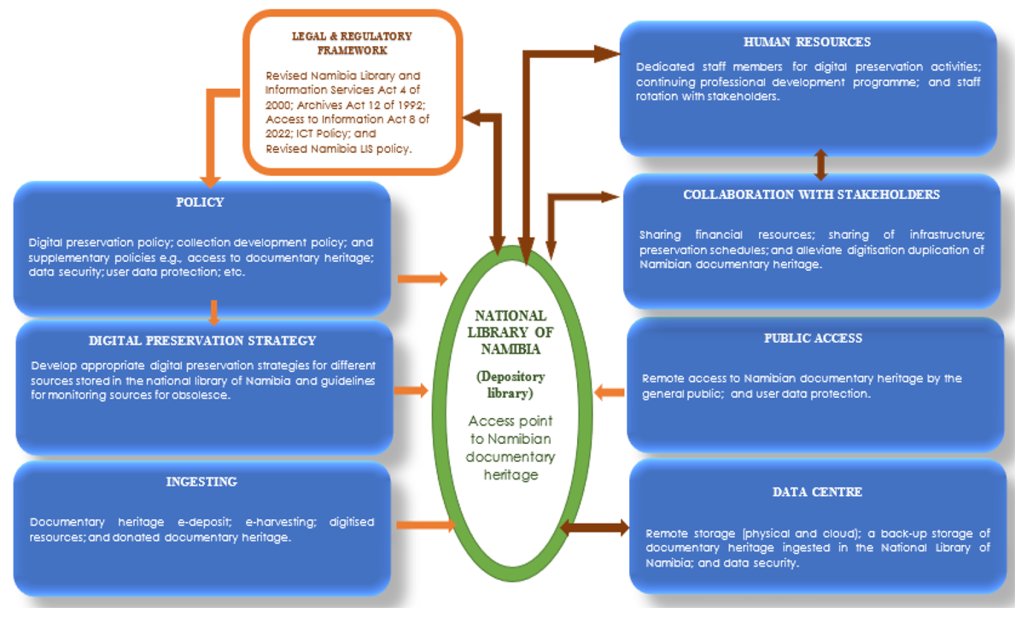
Figure 1. Proposed digital preservation framework for the National Library and the Namibia library and information sector
The article presents how the National Library of Namibia handles documentary heritage electronically deposited and harvested from publishers. The study concludes that the National Library of Namibia is determined to embrace e-deposit. However, the National Library’s efforts are hampered by challenges such as an outdated legal deposit framework, the lack of an internal policy to regulate the handling of e-deposit and the harvesting of electronic resources, limited appropriate technological infrastructure, and limited human resources. Despite these challenges, the study concludes that the National Library of Namibia has been conforming to the best practices in receiving e-deposits and harvesting electronic documents. The study proposes a digital preservation framework for the National Library as well as for the Namibia library and information sector. The proposed framework could assist the National Library of Namibia and the Namibia library and information sector in developing policies and guidelines to regulate Namibia’s documentary heritage, as the digital preservation of Namibian documentary heritage is necessary for posterity.
Alexandrov, G. (2018). Transformation of digital legal deposit in terms of legislation and public access. Knygotyra, 70, 136–153. https://doi.org/10.15388/Knygotyra.2018.70.11812
Andresoo, J. (2009). Towards the digital national library: The Estonian approach. Alexandria: The Journal of National and International Library and Information Issues, 21(1), 1–8. https://doi.org/10.7227/ALX.21.1.2
Cadavid, J. A. P. (2017). Evolution of legal deposit in New Zealand: From print to digital heritage. IFLA Journal, 43(4), 379–390. https://doi.org/10.1177/0340035217713763
Consultative Committee for Space Data Systems. (2012). Audit and certification of trustworthy digital repositories. CCSDS Secretariat. https://ccsds.org/Pubs/652x0m2.pdf
De Beer, M., Van der Merwe, M., Ball, L., & Fourie, I. (2016). Legal deposit of electronic books – a review of challenges faced by national libraries. Library Hi Tech, 34(1), 87–103. https://doi.org/10.1108/LHT-06-2015-0060
Dollar, C. M., & Ashley, L. J. (2015). Digital Preservation Maturity Model (DPCMM): Background and performance metrics. Digital Preservation Capability Maturity Model. https://anoldhanddigital.wordpress.com/wp-content/uploads/2018/10/be777-dpcmmbackgroundandperformancemetricsv2-7_july2015.pdf
Drijfhout, D. (2007). Digital preservation practices in South Africa: Review of existing policy, legislation, guidelines and standards. Alexandria: The Journal of National and International Library and Information Issues, 19(1), 57–63. https://doi.org/10.1177/095574900701900106
Elliott, A. (2011, August 13–18). Electronic legal deposit: The New Zealand experience [Paper presentation]. IFLA World Library and Information Congress 2011, San Juan, Puerto Rico. https://www.ifla.org/past-wlic/2011/193-elliott-en.pdf
Gibby, R., & Green, A. (2008). Electronic legal deposit in the United Kingdom. New Review of Academic Librarianship, 14(1–2), 55–70. https://doi.org/10.1080/13614530802519022
Hillebrecht, W. (2010). The preservation of the audio heritage of Namibia: Challenges and opportunities. Basler Afrika Bibliographien. https://www.baslerafrika.ch/wpcontent/uploads/WP_2010_1_Hillebrecht.pdf
Larivière, J. (2000). Guidelines for legal deposit legislation (Rev. ed.). UNESCO. https://unesdoc.unesco.org/ark:/48223/pf0000121413
Lavoie, B. (2014). The Open Archive Information System (OAIS) reference model: Introductory guide (2nd ed). Digital Preservation Coalition. http://www.dpconline.org/docs/technology-watch-reports/1359-dpctw14-02/file
Loubser, J. (2003). National Library of Namibia. In M. Dekker (Ed.), Encyclopaedia of library and information science (pp. 2023–2030). CRC Press.
Masekoameng, C. M. (2022). Digital preservation and access to the South African documentary national heritage at the National Library of South Africa [Master’s thesis, University of Limpopo].
Ministry of Education. (2012). Namibia library and archives services information bulletin.
Muir, A. (2001). Legal deposit and preservation of digital publications: A review of research and development activity. Journal of Documentation, 57(5), 652–682. https://doi.org/10.1108/EUM0000000007097
Nakale, A. L. N. (2023). Assessment of digital preservation maturity at the Office of the Prime Minister of Namibia [Master’s thesis, University of Namibia].
Namibia Library and Archives Services. (2018). Namibia Library and Archives Services annual report 2017/2018.
Neshat, N., & Ghasemi, R. (2022). A global view on digital legal deposit: What could be learned? Alexandria: The Journal of National and International Library and Information Issues, 32(1), 38–58. https://doi.org/10.1177/09557490231164896
Netshakhuma, S. (2021). Preservation of cultural heritage materials at the University of Witwatersrand. Collections: A Journal for Museum and Archives Professionals, 17(4), 411–429. https://doi.org/10.1177/1550190620987838
Ngulube, P. (2012). Ghosts in our machines: Preserving public digital information for the sustenance of electronic government in Sub-Saharan Africa. Mousaion: South African Journal of Information Studies, 30(2), 128–136.
Nsibirwa, Z., Hoskins, R., & Stilwell, C. (2014). Building the South African nation through legal deposit: The impact of legislation on preservation of digital materials. African Journal of Library, Archives & Information Science, 24(1), 53–65.
Republic of Namibia. (2000). Namibia Library and Information Service Act 4 of 2000. Government of Namibia.
Senzanje, N. (2014). Knowledge, attitudes and practices towards legal deposit by publishers of indigenous literature in Windhoek, Namibia [Master’s thesis, National University of Science and Technology].
Senzanje, N., & Jacobi, B. (2012). The National Library of Namibia. Namibia Library and Archives Service Information Bulletin, 1, 7–10.
Smith, J. G., Frouche, B., Muirhead, D., & Underwood, P. G. (2008). Namibian library and information service strategic assessment study: Baseline study interim report (Research report 10/2008). Directorate Namibia Library and Archives Services.
Spence, J. (2006). Preserving the cultural heritage: An investigation into the feasibility of the OAIS model for application in small organisations. Aslib Proceedings, 58(6), 513–524. https://doi.org/10.1108/00012530610713597
Stephens, A., & Gibby, R. (2011). National implementations of electronic legal deposit. Alexandria: The Journal of National and International Library and Information Issues, 22(1), 53–67. https://doi.org/10.7227/ALX.22.1.6
Stirling, P., Illien, G., Sanz, P., & Sepetjan, S. (2012). The state of e-legal deposit in France: Looking back at five years of putting new legislation into practice and envisioning the future. IFLA Journal, 38(1), 5–24. https://doi.org/10.1177/0340035211435323
Strodl, S., Becker, C., Neumayer, R., & Rauber, A. (2007). How to choose a digital preservation strategy: Evaluating a preservation planning procedure. Proceedings of the 7th ACM/IEEE-CS Joint Conference on Digital Libraries (pp. 29–38). ACM. https://doi.org/10.1145/1255175.1255181
Tsvuura, G. (2022). Institutional and legal frameworks supporting the digitisation of records and archives at two selected state universities in Zimbabwe. Mousaion: South African Journal of Information Studies, 40(4), 1–15. https://doi.org/10.25159/2663-659X/10322
Umana, S. (2019). Digital preservation in institutional repositories in Namibian academic libraries: A case study of the Namibia University of Science and Technology (NUST) and the University of Namibia (UNAM) [Master’s thesis, University of Namibia].
Van der Hoeven, J., & Van Wijngaarden, H. (2005). Modular emulation as a long-term preservation strategy for digital objects. In A. Rauber, S. Christodoulakis, & A M. Tjoa (Eds.), Research and advanced technology for digital libraries (pp. 9–24). Springer. https://doi.org/10.1007/11551362_47
Verheul, I. (2006). Networking for digital preservation: Current practice in 15 National Libraries. K. G. Saur. https://doi.org/10.1515/9783598440212
Verheul, I., & Van Wijngaarden, H. (2007). Measuring progress: Recent developments in digital preservation in the library community. Alexandria: The Journal of National and International Library and Information Issues, 19(2), 109–122. https://doi.org/10.1177/095574900701900204
Voutssas, J. (2012). Long-term digital information preservation: Challenges in Latin America. Aslib Proceedings, 64(1), 83–96. https://doi.org/10.1108/00012531211196729